
Starting Point Stroe

Routes from this starting point
-
Vatrop Route (purple)
- 4.89km
-
Waddenkant Route (red)
- 5.43km
-
Stroeerdijk Route (yellow)
- 9.34km
-
Nieuwland Route (black)
- 12.89km
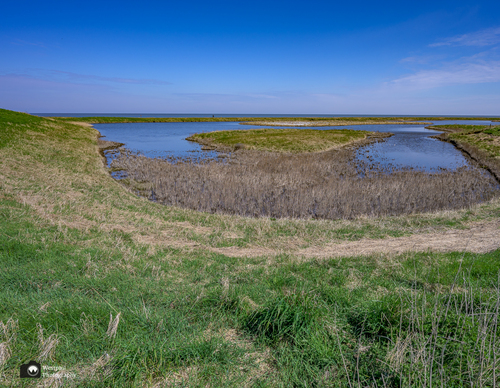
Until relatively recently, a Wadden Sea dyke was not needed here at Stroe. The land itself lay high enough – around 4 to 5 metres – thanks to the boulder clay of what was once almost an island in the Wadden Sea. The Wadden Sea was clearly visible from the Stroëerweg. After the 1980s, however, everything here was raised to Delta height, and a Wadden Sea dyke now stands in front of it. This was the true Wieringen: in Old Frisian, ‘wir’ means height or hill. More information can be found in the nearby Jan Lont Museum .
The Heidense Kapel (pagan chapel) in the cemetery at Stroe (at marker 55) is also worth a visit. A wooden church was built here on a pagan ritual site around 700; it was demolished in 1880 and rebuilt in stone in 2016.
- The purple Vatrop Route runs up the undulating Bierdijkerveldweg to the hamlet of Vatrop, a name that invites curiosity. It lies at 6.6 metres above sea level, with views nearby over the Kleiput, a true haven for birds. The route is waymarked in both directions with purple arrows.
This route was featured as the ‘Circular Walk of the Month’ in May 2021, in a feature written by the Westphil Wandelt bloggers. Read their walking report here.
- The red Waddenkant Route explores the Wadden side of Stroe as far as the hamlet of Noorderburen.
- The yellow Stroeërdijk Route runs across the low-lying pastures to the old southern side of Wieringen, where the eelgrass dyke once provided protection against the Zuiderzee. The route is waymarked in both directions with yellow arrows. Parts of the route are not mown frequently.
- The black Nieuwland Route partly follows the Stroeërdijk Route, then continues along the eastern ring dyke of the 19th-century Waard-Nieuwland polder. It then runs along the farm track of Jaap and Nils Koorn to Oosterland, Vatrop and the sea dyke. The route is waymarked in both directions with black arrows. Parts of the route are not mown frequently.
Read about the relationship between Wieringen and Seaweed.